“Don’t drill paradise”: Australia, world leaders urged to back TAFF and renewables-based electrification at COP31
ANTALYA, TÜRKIYE — Civil society challenged governments at COP31 to match their promises of ocean protection with concrete action against fossil fuel expansion, which are exhibited by threats faced by Palawan and other biodiversity hotspots across Southeast Asia.
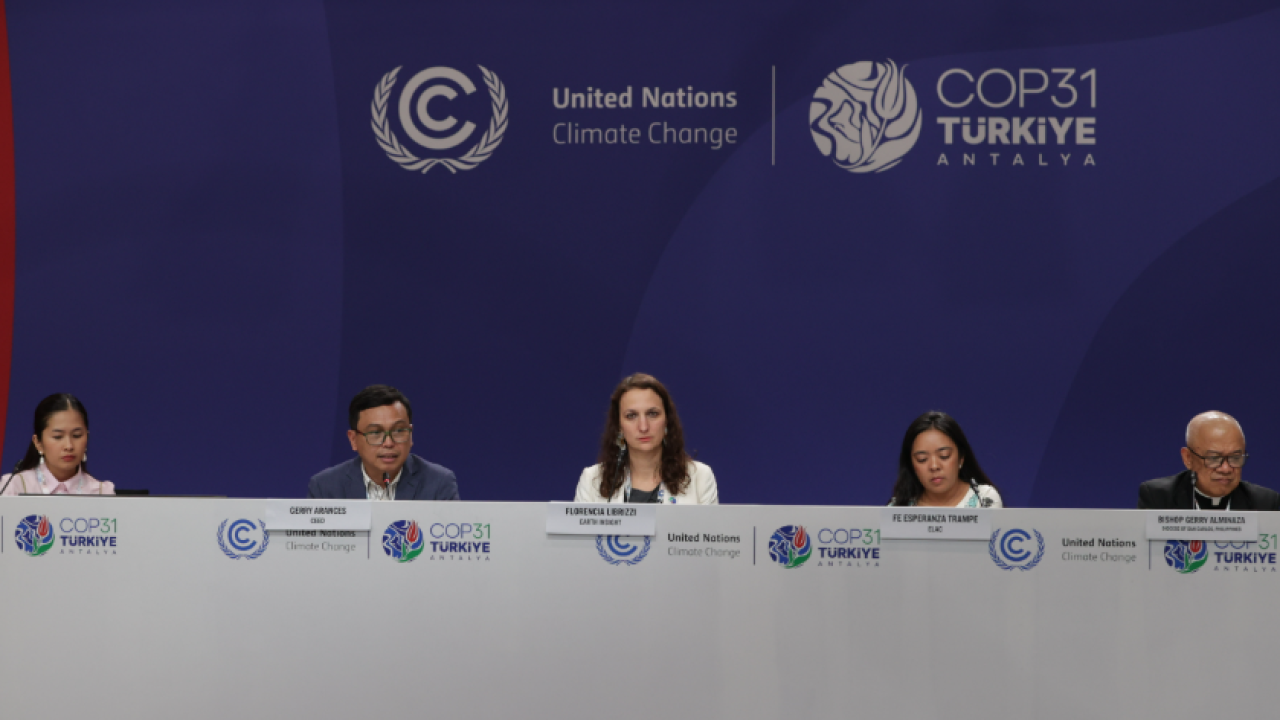
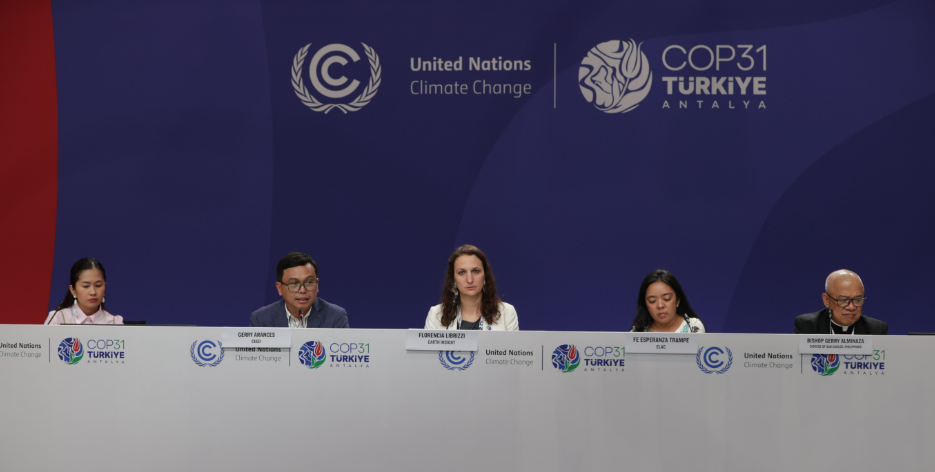
At the press conference “Don’t Drill Paradise: Protecting Palawan and Southeast Asia’s Ecological Frontiers from Fossil Fuels,” the Center for Energy, Ecology, and Development (CEED) raised alarm that 14 of the Philippines’ 22 active petroleum service contracts are concentrated in waters surrounding Palawan, a UNESCO Biosphere Reserve known as the country’s last ecological frontier.
At least four contract areas are near protected ecosystems, including the UNESCO World Heritage-listed Tubbataha Reefs Natural Park, while four fall within municipal waters. All 14 overlap Fisheries Management Areas, placing marine biodiversity, fishing communities and coastal livelihoods at risk.
“Palawan is not an empty stretch of ocean waiting to be drilled. It is home to irreplaceable marine ecosystems and communities whose food, livelihoods, and future depend on healthy seas. Australia and Türkiye have placed the ocean at the heart of COP31, but there can be no credible ocean agenda while governments continue opening some of our most biodiverse seas to oil and gas exploration,” said Gerry Arances, CEED Executive Director.
Referring to maps that exhibit the overlap of critical marine habitats, Earth Insight Deputy Director Florencia Librizzi explained how service contracts from a 2024 oil and gas exploration bid round “covers 20% of coral reefs in Palawan.”
“We really need to start thinking of what places we can and cannot drill,” Librizzi said. “The impacts are just too big to be afforded.”
Atty. Fe Esperanza Trampe, Legal Officer of Palawan-based Environmental Legal Assistance Center, explained how the Malampaya gas project–which had been the Philippines sole domestic source of gas power generation for decades, has had no benefit in Palawan.
“We are host to the Malampaya gas project, but the pipeline is not even connected to Palawan. We do not get any of the benefits of the gas pipeline, but it is in our territory. Now, more gas exploration is being pursued in our waters,” said Trampe.
“Our electrification rate right now is almost 80%, which is below the national average of about 96%. For so long, our province’s energy needs are supplied by diesel and bunker fuels, which have kept us energy insecure. We were told that we need a coal plant, even when a national coal moratorium is in place. But even after this coal plant was built, energy insecurity continued. Now, a new mainland energy masterplan still calls for expanding coal and diesel. The oil and gas they aim to extract in Palawan will not even be used to power Palawan,” explained Trampe.
The groups warned that petroleum contracts involving companies from Australia, Israel, the United States, the United Kingdom, Malaysia and the Philippines underscore the international responsibility to prevent fossil fuel expansion in ecologically critical areas.
“In the Philippines itself, oil and gas blocks directly overlap 20% of the country’s coral reefs, 18% of seagrass beds, and 4% of mangrove areas. We see how biodiversity is severely compromised, but also, all of the ecosystem services that we also bring to the climate ambitions we are discussing here in Antalya. These services matter to people, from food to livelihood, coastal protection, and well-being of communities,” added Librizzi.
Bishop Gerry Alminaza, President of Caritas Philippines, stressed the moral responsibility of governments to protect creation and defend communities whose survival depends on healthy ecosystems.
“The plight of Palawan makes us ask: What kind of development puts at risk the very ecosystems that sustain life? Who benefits from this development? Who bears its burdens? And who will answer when the damage becomes irreversible?” asked Bishop Alminaza.
“Here at COP31, we call on governments to accelerate the transition away from fossil fuels, halt new oil and gas exploration in biodiversity-rich and ecologically sensitive areas, and uphold the rights and meaningful participation of affected communities. COP31 President for negotiations, Australia, in particular, needs to step up. Together with Turkiye, it promised a climate conference that champions the ocean. Yet it allows its companies to take part in destroying our last ecological frontier,” Bishop Alminaza said.
The groups said Palawan’s predicament mirrors mounting threats across Southeast Asia, where oil and gas exploration, liquefied natural gas (LNG) infrastructure and shipping activities increasingly encroach upon marine ecosystems and traditional fishing grounds.
CEED also said Palawan’s situation underscores how COP31’s emphasis on electrification must be founded on renewable energy, which is the only way that affordable and reliable electricity can truly be secured for the Philippines, Southeast Asia, and all regions where access to electricity remains limited or too costly.
“The Philippines is among the countries hardes hit by the energy crisis this year, owing to its extreme reliance on fossil fuels. Since the start of the current government, electricity prices in gass-reliant Metro Manila have risen by about USD 10 cents per kilowatthour. Meanwhile, so many of our people also still remain unelectrified in centralized, fossil dominated grids,” explained Arances.
“The Presidency’s electrification agenda can only truly be climate action if it is powered by renewable energy. If the electricity we produce continues to come from coal, gas, and oil, then the world is simply sending biodiversity and communities to worse suffering. For a region that has an extreme abundance of renewable energy potential, there is no reason to sacrifice our seas and people’s livelihoods for energy that will only bring them harm,” Arances said.
“So much of Palawan remains untouched, but so much of it is also under threat,” Trampe remarked. “Fishers are the backbone of our society in Palawan. I grew up in Palawan and was always assured that we will always have fish, but now I cannot be as sure anymore.”
“When we talk about the energy transition, I hope that we do not regress. We cannot regress. As a Palaweno, we cannot pay for this regression. Our forests and seas are sacred to us. We need them intact to combat the most negative effects of climate change,” said Trampe. “Don’t drill paradise. Don’t drill my home.”
“Here in Antalya, we really need to make sure that we halt fossil fuel expansion. This goes hand in hand with the transition away from fossil fuels. Science has already told us what we must do. There is no other way to go around it. We also really need to consider very hard establishing fossil-free zones. This is key for climate, but also for biodiversity and human rights–especially for marine biodiversity areas of this importance,” Librizzi said.