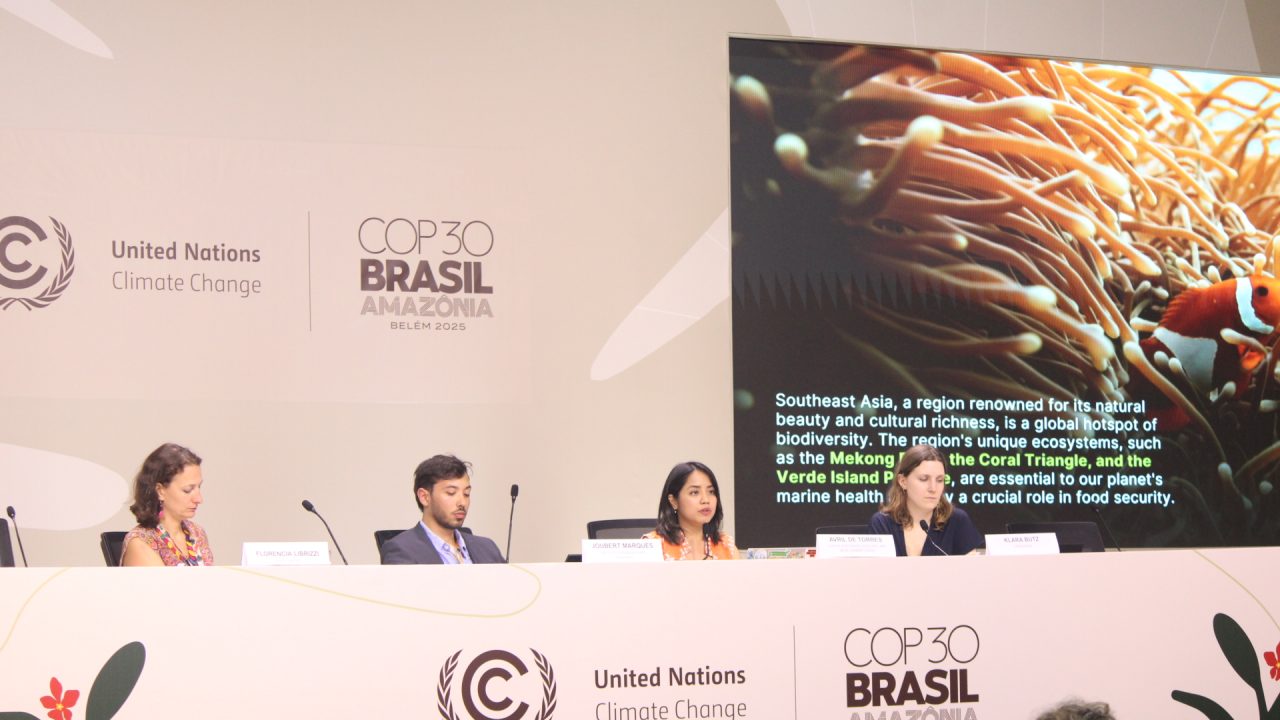
Call to stop fossil fuel threats in biodiversity hotspots in spotlight at COP30
Belem, Brazil – Civil society experts took to the COP30 climate talks stage to call for an end to threats from continuing expansion of coal, gas, and oil activities in highly biodiverse areas across the globe, from the Amazon to the ‘Amazon of the ocean’ in Southeast Asia – a reality which the groups say is incompatible with global leaders’ aim to meet climate and nature commitments.
New maps reveal that ongoing or planned oil and gas expansion, including the buildout of liquefied natural gas (LNG) facilities, significantly overlap with marine and terrestrial biodiversity hotspots. In the Amazon, about 25 million hectares or 14% of the key biodiversity areas overlap with oil and gas explorations, while 16% of oil and gas blocks overlap in the Coral Triangle region with 210,000 square kilometers of conservation areas and 80 protected areas.
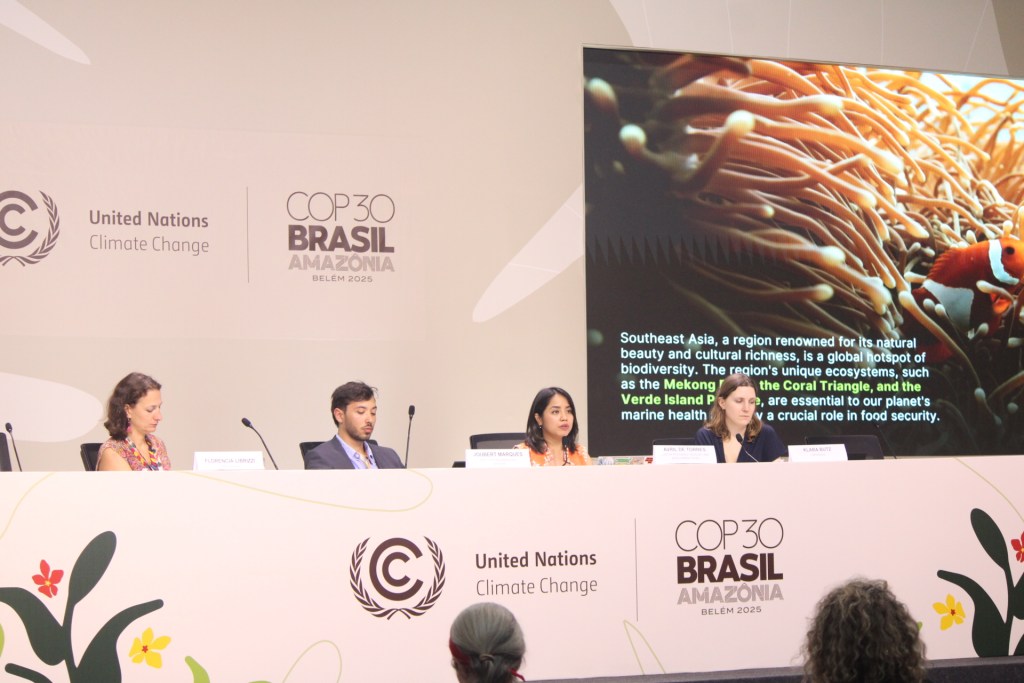
“It is essential that governments recognize this pattern – oil and gas expansion is not only a climate threat. It’s directly threatening indigenous peoples, local communities, nature, food security, livelihoods, and ultimately the future of all. So if we’re really serious about protecting these ecosystems, we must align policy and finance with the transition away from fossil fuel expansion, both on land and at sea,” said Florencia Librizzi, Deputy Director at Earth Insight.
The annual climate negotiations is currently underway in the city of Belem in Brazil’s state of Para, dubbed as the gateway to the Amazon – whose rainforest and reef systems are both endangered by new fossil fuel extraction plans.
“For more than 30 years, we have been fighting in Brazil for a just energy transition and to defend the rights of communities and the protection of the Amazon. It’s one of our biggest fights, and we are now facing a massive problem here at the COP30. While the world and Brazil talk about a just energy transition, we have seen a massive fossil fuel expansion in the Amazon and all over [South] America. All of this expansion puts the Amazon at risk,” said Joubert Marques, Climate and Geosciences Analyst of Instituto Internacional Arayara.
Studies show that the world has reached a catastrophic climate tipping point as global temperature breaches 1.5°C. The groups warn that this could result in more deadly typhoons for climate-vulnerable countries like the Philippines, which recently endured back-to-back typhoons just within the past month.
“Southeast Asia houses a third of the world’s coastal and marine habitats, a third of the world’s coral reef species, more than half of the world’s tropical peatlands, and almost half of the world’s mangrove areas. Within our region lie the Mekong Delta, the Coral Triangle, which is the global center for marine biodiversity – and our very own Amazon of the Ocean, that is the Verde Island Passage or VIP. But today, our waters and peoples are under siege. The world has crossed its first catastrophic climate tipping point–the widespread death of warm water coral reefs, on which we and other species depend. And, with warmer oceans also come stronger and deadlier typhoons that are condemning us in a cycle of destruction and rebuilding, again and again,” said Atty. Avril De Torres, Deputy Executive Director of the Center for Energy, Ecology, and Development.
“Our government also remains incapable of holding accountable the fossil fuel developer that is also behind the biggest oil pollution in the history of the Philippine seas, which happened right in the VIP. What makes this even worse is that the government has already pledged to prioritize the VIP in its conservation efforts under its own 30×30 commitment, while simultaneously allowing the very activities that endanger it. This contradiction is not unique to the Philippines. It is mirrored across our region and beyond,” De Torres added.
The groups highlighted the role of financing in fossil fuel buildout. Currently, European financier like Deutsche Bank, HSBC, and UBS are financing projects in two key biodiversity hotspots. Specifically, while UBS is building gas power plants in the Amazon in Brazil, it is also the third largest European investor in San Miguel Corporation, a company driving the gas buildout in the Verde Island Passage in the Philippines.
“This is what the banks and investors need to know: there is a red line that you can’t cross – no more money for destruction of indigenous territories, no money for indigenous projects in key biodiversity areas, and no money for fossil fuel expansion at all,” said Klara Butz, Campaigner of Germany-based fossil finance watchdog Urgewald.
“We call on [global leaders] to recognize the role of fossil fuels in endangering marine and terrestrial ecosystems, and harming communities. Second, declare key biodiversity areas and wildlife corridors, such as the Mekong Delta, the Coral Triangle, and the Verde Island Passage, as no-go zones for all extractive and destructive activities. And, finally, commit to an accelerated protection and recovery of biodiversity to achieve the 30×30 global target, requiring a transition away from environmentally destructive production practices,” De Torres concluded.