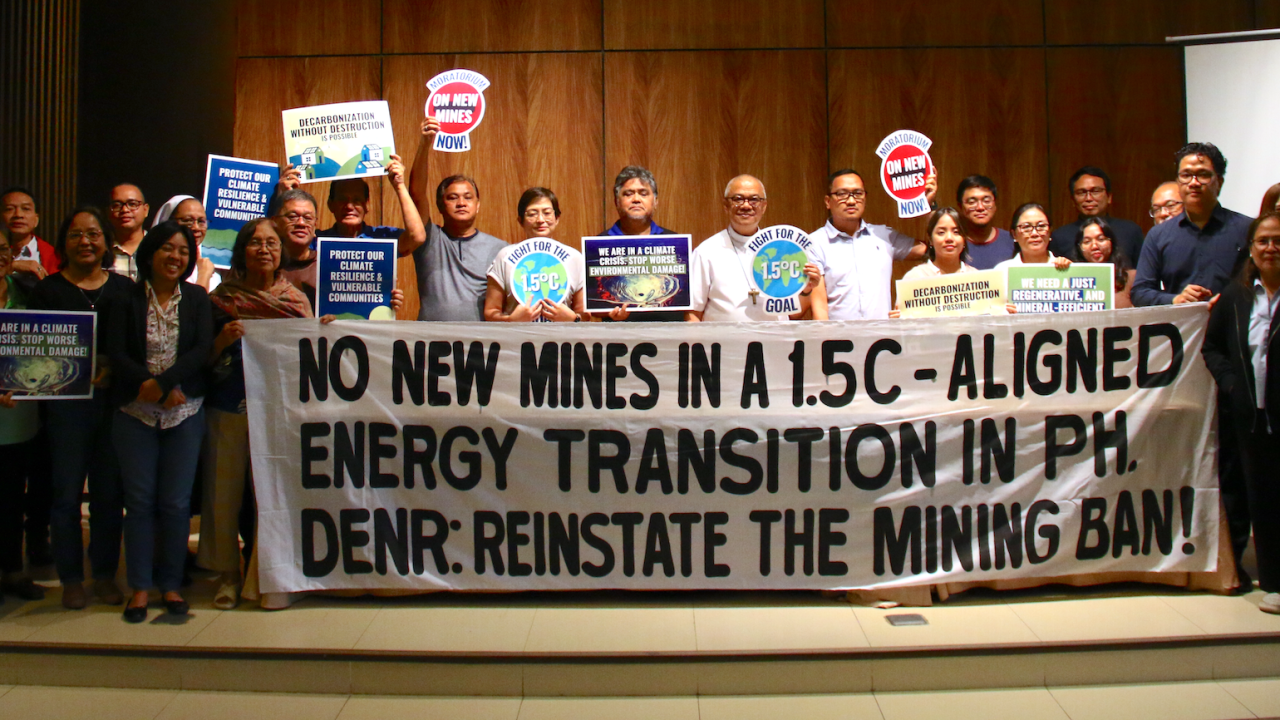
Groups launch watchdog campaign on mining and energy transition in PH, call for ban on new mines
Environmental groups, energy transition advocates, mining community members, and other sectoral representatives on Friday launched a campaign calling on government authorities to ban the opening of new mines and to implement mineral-efficient energy transition pathways for the Philippines.
In a press conference, the groups called for caution against increasing mining operations in the country as promoted by government and industry members alike, purportedly for the Philippines’ transition to clean energy. The global push for decarbonization and energy transition is projected to drive the demand for transition minerals up to six times the present, according to the International Energy Agency (IEA).
“The Philippines has a potential for renewables enough for a 100% transition aligned to the 1.5C climate goal. Our analyses show that mineral requirements for it can already be met without opening new mines. This is especially when we do away with promotion of private over public transportation development, and continued preference for centralized power systems,” said Engr. Joshua Lopez, Senior Policy Analyst of the Center for Energy, Ecology, and Development (CEED).
CEED’s analyses show that the Philippines will need 1,376 kilotons of copper and 29.5 kilotons of nickel to fully transition to 100% renewable energy generation, based on 1.5 degree C-aligned pathways as described in a 2023 study with Berlin-based think-tank Climate Analytics. This copper amount could be produced in 4.6 years, and 1.2 months for nickel, at the production rate during the time that the 2012 mining moratorium was in place.
“Instead of promoting more extraction that would bring destruction to our remaining watersheds, vulnerable communities, and overall climate resilience, the Philippine government must advance a mineral-efficient, regenerative energy transition. A ban on new mines should be the order of the day,” added Lopez.
The groups raised the call a day after the Department of Environment and Natural Resources (DENR) and other agencies affirmed efforts to ensure a sustainable and vibrant mining industry at a forum organized by the Chamber of Mines of the Philippines.
“It seems we have yet to learn our lessons from years of devastating climate impacts. Today, the Philippine government is fast-tracking policies to improve efficiency in mining application processes. Efficiency, in itself, is not necessarily problematic – but it is a cause for concern when it comes at the cost of communities. Such is also the case for the new mining framework being put forward by the administration, which in effect brings a decrease in tax revenue from the mining sector. This, in a manner that is not data-driven, and is instead based largely on the interests of an extremely opaque industry,” said Dr. Cielo Magno, President of Bantay Kita and former Undersecretary of the Department of Finance.
The groups are alarmed that the push for a vibrant mining sector gravely runs contrary to the Philippines’ interest being among countries in the world most vulnerable to the climate crisis, and ranked anew as the most at-risk in the world to disasters in the 2024 World Risk Index.
Recalling the tragic landslides suffered by a mining town in Mindanao earlier in the year, Bishop Gerry Alminaza in the press conference stressed that “Caritas Philippines [has] called for a national moratorium on mining. We reiterate this demand. We believe in a full renewable energy transition for the Philippines. We also believe, as is backed by science, that it needs not come at the expense of people and ecological justice.” Alminaza serves as Vice Chairperson of Caritas Philippines and Convenor of the EcoConvergence National Hub, which advances ecological causes of the Catholic Bishops’ Conference of the Philippines.
The press event was also joined by Sanlakas Secretary General Atty. Aaron Pedrosa, and Mr. Rene Pamplona of the Convergence of Initiatives for Environmental Justice (CIEJ), and a number of other organizations.